Best Geysers in Yellowstone (What’s Actually Worth Seeing)

This post may contain affiliate links. If you book through them, I may earn a small commission at no extra cost to you. I only recommend options that simplify planning and improve your trip experience.
Table of Contents
Yellowstone has more geysers than anywhere else on Earth, but that doesn’t mean you need to see all of them.
For most first-time visitors, the better strategy is to focus on a handful of Yellowstone’s most memorable geysers—then leave enough time to actually enjoy the Upper Geyser Basin instead of racing from one geothermal stop to another.
Old Faithful is still worth seeing, but it isn’t the only geyser I’d prioritize. Grand Geyser can deliver a much more dramatic eruption, Riverside Geyser has one of the prettiest settings, and Castle Geyser is worth adding when you’re already exploring the Old Faithful area.
And while Grand Prismatic Spring isn’t a geyser, it’s close enough—and spectacular enough—that most first-time visitors should combine it with their geyser day.
This guide covers the best geysers in Yellowstone, what makes each one worth your time, and how to combine them without spending your entire day chasing eruptions.
Quick Answer
If this is your first Yellowstone trip, prioritize Old Faithful, Grand Geyser, Castle Geyser, and Riverside Geyser. All four are in the Upper Geyser Basin, which makes this the best place to concentrate your time.
If eruption predictions line up with your visit, Daisy Geyser and Beehive Geyser are also worth watching. Don’t build your entire day around seeing every predicted eruption, though. Yellowstone’s geysers are natural features, and eruption timing can change.
Then combine the Upper Geyser Basin with Grand Prismatic Spring at Midway Geyser Basin. It isn’t technically a geyser, but it’s one of Yellowstone’s essential geothermal sights and fits naturally into the same day.
If you only remember one thing: Don’t leave immediately after watching Old Faithful erupt. Some of Yellowstone’s best geothermal experiences are along the trails and boardwalks beyond it.
Where Are the Best Geysers in Yellowstone?

You don’t need to drive all over Yellowstone to see several of its best geysers.
The Upper Geyser Basin, surrounding Old Faithful, contains the greatest concentration of geysers in the park and should be the priority for most first-time visitors. Old Faithful, Castle Geyser, Grand Geyser, Riverside Geyser, Daisy Geyser, and Beehive Geyser are all found within this broader area.
That’s what makes the Upper Geyser Basin so useful: you can park once and explore multiple major geothermal features on foot instead of repeatedly moving your vehicle.
Plan on doing more walking here than you might expect. The boardwalk and trail system extends well beyond the Old Faithful viewing area, and some of the best features require walking farther into the basin.
Grand Prismatic Spring is nearby but not part of the Upper Geyser Basin. It’s located at Midway Geyser Basin, so you’ll need to drive between the two areas. The Grand Prismatic Overlook is reached from the Fairy Falls trailhead rather than from the Midway boardwalk.
Black Sand Basin is also close to Old Faithful and can be an easy additional geothermal stop if you have time.
I wouldn’t automatically add every nearby basin simply because it’s on the map. Your goal isn’t to collect geothermal stops—it’s to spend enough time at the best ones to make the day worthwhile.
WTT Tip: Park at Old Faithful and explore the Upper Geyser Basin on foot before moving your vehicle. Constantly driving between individual geothermal features usually wastes more time than it saves.
2026 Note: Biscuit Basin remains closed until further notice following the 2024 hydrothermal explosion, so don’t build it into your geothermal route. Check current Yellowstone conditions before your trip in case access changes.
1. Old Faithful — Best for First-Time Visitors

Old Faithful is Yellowstone’s most famous geyser, and despite the crowds, I still think it’s worth seeing on a first trip.
Its biggest advantage isn’t that it’s Yellowstone’s largest or most dramatic geyser. It’s that eruptions are frequent enough to be predicted with reasonable accuracy, making Old Faithful much easier to work into an itinerary than many of Yellowstone’s less predictable geysers.
Instead of planning around a fixed eruption interval, check the current eruption prediction when you arrive. If you’ve just missed an eruption, use the waiting time to explore the surrounding Upper Geyser Basin rather than standing at the viewing area the entire time.
Why Old Faithful Is Worth It
The eruption itself is iconic, but the location is what makes this stop especially valuable. Old Faithful serves as a natural starting point for exploring the Upper Geyser Basin, where several of the other geysers on this list are located.
That means you aren’t driving across Yellowstone simply to watch one eruption. You can park, see Old Faithful, and continue walking through one of the most impressive geothermal areas in the park.
What Most Visitors Miss
Don’t watch Old Faithful erupt and immediately return to your car.
The trails and boardwalks extending beyond the main viewing area lead past numerous hot springs, pools, smaller geysers, and several of the major geysers we’ll cover next.
If you have enough time, Old Faithful should be the beginning of your Upper Geyser Basin visit—not the entire experience.
WTT Tip: Check the eruption predictions for Old Faithful and the other predicted geysers when you arrive. If another major geyser has a favorable prediction window, use that information to decide which direction to walk through the basin.
Don’t Skip Grand Prismatic Spring
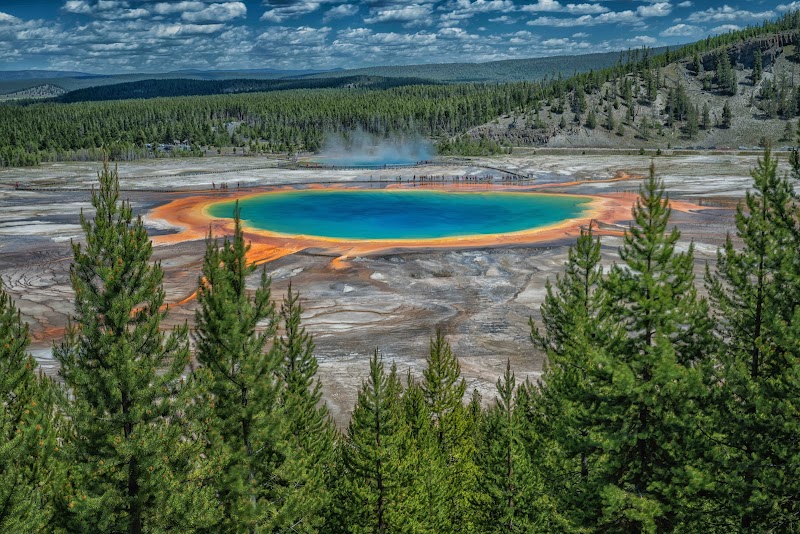
Grand Prismatic Spring isn’t a geyser, so I’m not counting it in the ranking. But if you’re already spending a day exploring Yellowstone’s geysers, this is the geothermal feature I would make room for anyway.
Located at Midway Geyser Basin, Grand Prismatic is Yellowstone’s largest hot spring and one of the park’s most recognizable sights. Its enormous size and bands of vivid color make it a completely different experience from watching a geyser erupt.
Boardwalk or Overlook?
If you have time, the two viewpoints offer different experiences.
The Midway Geyser Basin boardwalk takes you alongside Grand Prismatic Spring, where you can appreciate its size, steam, and intense colors at ground level. The downside is that being so close makes it difficult to see the entire spring at once.
For the classic elevated view, use the Grand Prismatic Overlook, accessed from the Fairy Falls trailhead. From above, you get a much better perspective of the spring’s full shape and colors.
If I could choose only one view on a clear day, I’d choose the overlook.
Keep in mind that cool temperatures and heavy steam can obscure the spring, particularly earlier in the morning. Grand Prismatic often shows its colors better once the day has warmed.
WTT Tip: Don’t confuse the Midway Geyser Basin parking area with the Fairy Falls trailhead. Use Midway for the boardwalk and Fairy Falls for the overlook.
2. Castle Geyser — Best for a Long, Powerful Eruption
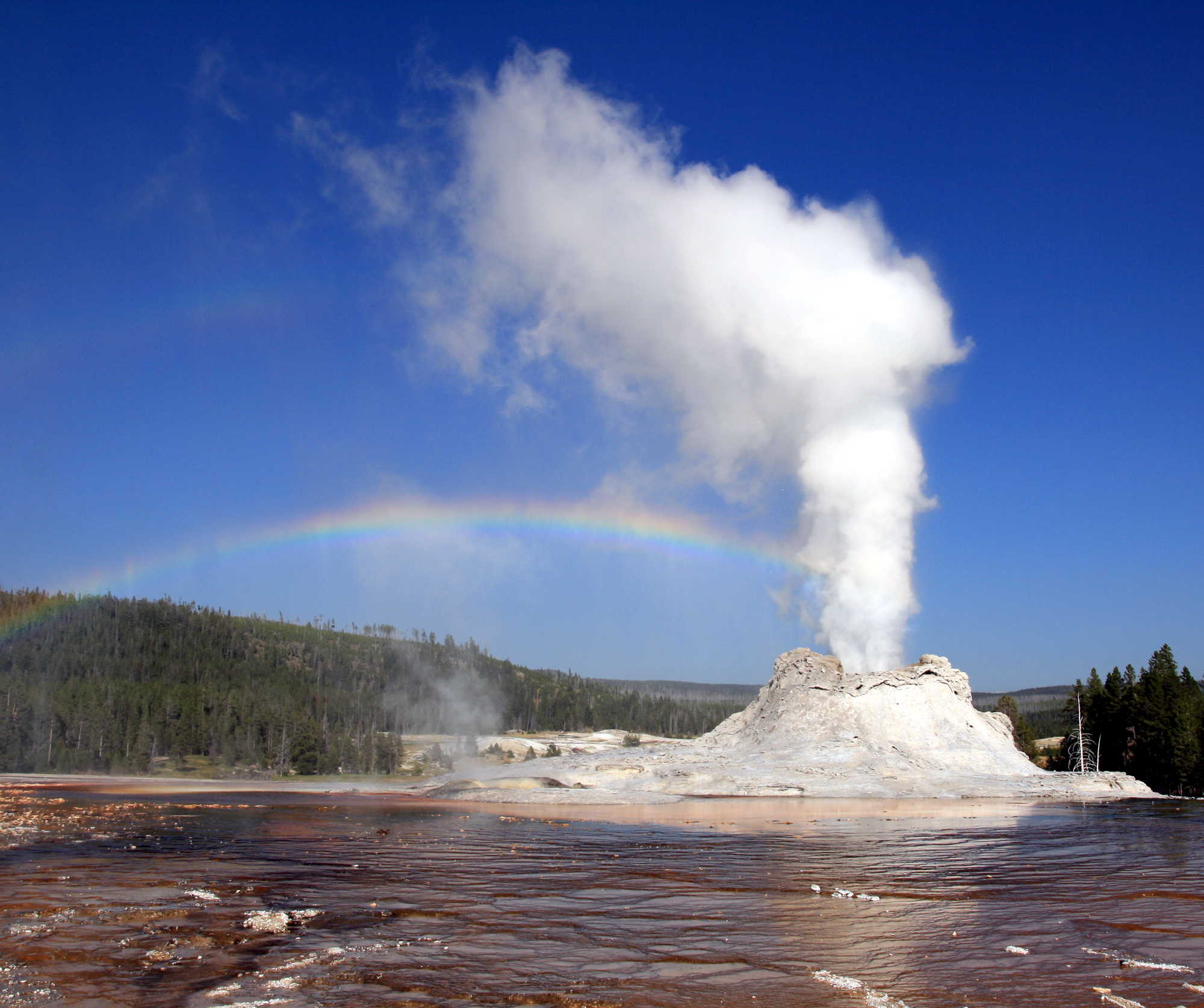
Castle Geyser is one of the easiest major geysers to add to an Old Faithful visit because it’s located along the Upper Geyser Basin trail system.
Even when Castle isn’t erupting, its large cone makes it worth noticing. The formation has been built up by thousands of years of mineral deposits and looks dramatically different from the relatively simple opening at Old Faithful.
If an eruption prediction lines up with your visit, Castle Geyser is worth waiting for.
Why Castle Geyser Stands Out
Castle’s eruptions can last much longer than the main water phase at Old Faithful, followed by an extended steam phase. That makes the experience feel quite different from simply watching another geyser erupt.
The bigger advantage is that you don’t need to make a separate driving stop for it. Castle is part of the same Upper Geyser Basin experience as Old Faithful, Grand Geyser, and Riverside Geyser.
If the prediction window doesn’t work with your day, however, I wouldn’t spend hours waiting just to check it off the list. Continue exploring the basin and take advantage of whichever major geysers happen to align with your visit.
WTT Tip: Treat eruption predictions as opportunities rather than appointments. If Castle’s prediction works with your walk through the basin, take advantage of it. If it doesn’t, Yellowstone has plenty more to see.
3. Riverside Geyser — Best Scenic Setting

Riverside Geyser has one of the most distinctive settings of Yellowstone’s major geysers.
Instead of erupting vertically from an open basin, Riverside sits along the Firehole River, sending water and steam out over the river during an eruption. That setting alone makes it feel noticeably different from Old Faithful, Castle, and Grand Geyser.
It’s also farther into the Upper Geyser Basin, so reaching it requires more walking than simply stopping at Old Faithful.
Is Riverside Geyser Worth the Walk?
Yes—if its eruption prediction works reasonably well with your visit.
Riverside is particularly worthwhile when you’re already walking farther into the Upper Geyser Basin. Rather than treating it as a separate attraction, combine it with the other geothermal features along the route.
If the predicted eruption would require a very long wait, I wouldn’t rearrange an entire Yellowstone day around it. Continue exploring and see which predicted geysers line up naturally with your time in the basin.
Because Riverside sits beside the river, wind and sunlight can also change the appearance of an eruption. Under the right conditions, the spray can create a rainbow.
WTT Tip: If you’re walking to Riverside, give yourself time to enjoy the route. Some of the appeal of the Upper Geyser Basin comes from the geothermal features you encounter between the famous geysers—not just the eruptions at the end.r geothermal areas.
4. Grand Geyser — Best for a Dramatic Eruption

If you want to see a geyser that can feel more dramatic than Old Faithful, Grand Geyser is one of the best to watch for while exploring the Upper Geyser Basin.
Its eruptions can send powerful bursts of water high into the air, often with multiple bursts during the same eruption. The result can be one of the most impressive geyser experiences of a Yellowstone trip.
Why Grand Geyser Is Worth Prioritizing
Grand Geyser is one of the geysers for which Yellowstone provides eruption predictions, which gives you a better chance of working it into your day than a completely unpredictable geyser.
But a prediction is still a window, not an exact appointment.
If Grand’s predicted window overlaps with the time you already plan to spend in the Upper Geyser Basin, I would make an effort to see it. This is one eruption that’s worth adjusting your walking route for.
The Trade-Off
Seeing Grand Geyser can require patience.
You may arrive during its prediction window and still have to wait, so don’t build an overly rigid itinerary around a specific eruption time.
This is also why I wouldn’t try to schedule Old Faithful, Castle, Riverside, Grand, and every other predicted geyser into one perfectly timed sequence. Check the current predictions, identify the best opportunities, and let the day unfold from there.
WTT Tip: If Grand Geyser’s prediction window lines up well with your visit, put it near the top of your list. If the timing doesn’t cooperate, don’t let one missed eruption derail the rest of your Yellowstone day.
5. Beehive Geyser — Best Bonus If You’re Lucky
Beehive Geyser can produce one of the most powerful and exciting eruptions in the Upper Geyser Basin.
The problem is timing.
Unlike Old Faithful, you shouldn’t arrive at Yellowstone assuming you’ll be able to schedule Beehive neatly into your day. Its eruptions are less predictable, although activity from a nearby indicator geyser can sometimes provide a short warning before an eruption.
That’s why I think of Beehive as a high-value bonus rather than a geyser you should build your itinerary around.
If you’re near Old Faithful and learn that Beehive may erupt soon, it’s absolutely worth considering. If nothing is happening, keep exploring rather than waiting indefinitely.
Why Beehive Makes the Top Five
When Beehive erupts, the water column can be remarkably powerful and the viewing area allows you to experience the eruption from relatively close range.
That combination makes it memorable enough to earn a spot on this list—even though your chances of seeing it aren’t as easy to plan as Old Faithful or some of the other predicted geysers.
WTT Tip: If you hear that Beehive’s indicator geyser has started, pay attention. That can signal an upcoming Beehive eruption—but don’t rely on Beehive when building the day’s itinerary.
Other Geysers Worth Seeing
The Upper Geyser Basin contains far more than five worthwhile geysers. If the timing works during your visit, two others are especially worth noticing.
Daisy Geyser
Daisy Geyser is a good addition when its eruption prediction lines up with your walk through the basin.
Its location is somewhat removed from the main Old Faithful-to-Morning Glory Pool route, so I wouldn’t automatically detour for it when you’re short on time. But if you have several hours in the basin and the prediction is favorable, Daisy can be an excellent bonus eruption.
Grotto Geyser
Grotto Geyser is worth seeing even when it isn’t erupting.
Its unusual, irregular cone looks dramatically different from Yellowstone’s more familiar geyser formations. You’ll encounter it while exploring farther into the Upper Geyser Basin, making it an easy feature to appreciate as part of the walk rather than something you need to schedule.
The larger lesson is that you don’t need to arrive with a checklist of every geyser you intend to see. Prioritize the major ones, check the day’s eruption predictions, and take advantage of whatever Yellowstone gives you while you’re there.
What’s NOT Worth Prioritizing
The biggest mistake you can make on a Yellowstone geyser day isn’t choosing the wrong geyser. It’s trying to see too many geothermal areas in one day.
Yellowstone has an enormous number of geysers, hot springs, fumaroles, and other thermal features. Once you start trying to check off every basin and every predicted eruption, you can spend more time watching the clock and moving your car than actually enjoying them.
For a first trip, I wouldn’t worry about seeing every minor geyser or stopping at every geothermal basin simply because you drive past it.
Instead, give yourself enough time to properly explore the Upper Geyser Basin, add Grand Prismatic Spring, and let the day’s eruption predictions determine which additional geysers you see.
It’s also okay to miss an eruption.
If seeing Castle, Riverside, or Grand requires waiting so long that you’re sacrificing another major part of your Yellowstone itinerary, keep moving. Geyser predictions are useful planning tools, but they shouldn’t control your entire day.
The exception is when geothermal features are one of the main reasons you’re visiting Yellowstone. In that case, spending most of a day—or even returning to the Upper Geyser Basin more than once—can absolutely be worthwhile.
WTT Tip: Decide how much of your Yellowstone day you’re willing to devote to geysers before you arrive. That makes it much easier to decide whether a predicted eruption is worth waiting for when you’re actually in the basin..
Best One-Day Geothermal Strategy
If you have one day to focus on Yellowstone’s geothermal features, I would concentrate on Old Faithful and the Upper Geyser Basin first, then Grand Prismatic Spring.
Start at the Old Faithful area and check the current eruption predictions when you arrive. Old Faithful is the obvious priority, but also look at the prediction windows for Grand, Castle, Riverside, and Daisy Geysers.
Use those predictions to shape your walk through the Upper Geyser Basin rather than trying to follow a rigid schedule.
If Grand or another major geyser has a favorable prediction window, adjust your walking route to see it. If the timing doesn’t cooperate, continue exploring instead of spending hours waiting for one eruption.
Allow several hours if you want to walk beyond Old Faithful and see more of the basin. This is one Yellowstone area where slowing down usually gives you a better experience than rushing through several separate stops.
Afterward, drive north to Grand Prismatic Spring.
Choose the Midway Geyser Basin boardwalk if you want to experience the spring from ground level. If seeing the full shape and colors from above is more important, use the Grand Prismatic Overlook from the Fairy Falls trailhead.
If you still have time after Old Faithful, the Upper Geyser Basin, and Grand Prismatic, add another geothermal area based on your overall Yellowstone itinerary rather than simply choosing the next stop on a checklist.
Where Should You Stay for a Geyser-Focused Day?
If Yellowstone’s geyser basins are a major priority, staying near Old Faithful or West Yellowstone can make an early start easier and reduce unnecessary driving.
You can compare my favorite Yellowstone hotels on Expedia once you know which part of the park fits the rest of your itinerary.
For a more complete breakdown of the lodging options, see Best Hotels Near Yellowstone National Park.
What to Bring
You don’t need specialized gear for a Yellowstone geyser day, but expect more walking and sun exposure than you might assume from looking at a map.
Bring comfortable walking shoes, water, sun protection, and layers for changing temperatures. A portable charger can also be useful if you’re using your phone for photos, maps, and current geyser information throughout the day.
For the complete trip rather than another gear list here, use my Yellowstone Packing List.
Frequently Asked Questions
What is the most famous geyser in Yellowstone?
Old Faithful is the most famous geyser in Yellowstone and the one most first-time visitors recognize.
Its popularity comes partly from its frequent eruptions and the ability to predict upcoming eruptions within a window. It’s also easy to reach and surrounded by the much larger Upper Geyser Basin, so seeing Old Faithful can be the starting point for several hours of geothermal sightseeing.
What geysers should I not miss in Yellowstone?
For a first trip, I would prioritize Old Faithful, Grand Geyser, Castle Geyser, and Riverside Geyser.
Beehive Geyser is also worth seeing if you’re lucky enough to be nearby when an eruption is expected.
You don’t need to see every geyser on this list to have a great visit. Check the current predictions and concentrate on the eruptions that fit naturally into your time in the Upper Geyser Basin.
Is Old Faithful worth it?
Yes. Old Faithful is crowded and heavily visited, but it’s still worth seeing on a first Yellowstone trip.
The mistake is treating Old Faithful as a quick roadside attraction. Give yourself enough time to explore beyond the main viewing area and see more of the Upper Geyser Basin.
What is the best geyser basin in Yellowstone?
For most first-time visitors, the Upper Geyser Basin is the best geyser basin to prioritize.
It contains Old Faithful along with Grand, Castle, Riverside, Daisy, Beehive, and numerous other geothermal features. Because so much can be explored on foot from the Old Faithful area, you can experience several major geysers without repeatedly moving your vehicle.
Is Grand Prismatic Spring a geyser?
No. Grand Prismatic Spring is a hot spring, not a geyser.
It’s included in this guide because it’s one of Yellowstone’s most important geothermal features and is close enough to the Upper Geyser Basin to combine naturally with a geyser-focused day.
How do I know when Yellowstone’s geysers will erupt?
Yellowstone provides eruption predictions for several geysers, but those predictions are given as time windows rather than guaranteed exact eruption times.
Check the current predictions when you arrive in the Old Faithful area and use them to help plan your walk through the Upper Geyser Basin.
Because geysers are natural systems, eruption patterns can change. Treat the predictions as planning tools rather than a schedule you have to follow perfectly.
How much time should I spend at the Upper Geyser Basin?
Allow at least a few hours if you want to do more than watch Old Faithful and leave.
The exact amount of time depends on how far you walk and whether you decide to wait for predicted eruptions. Travelers especially interested in geothermal features can easily spend a large portion of the day exploring the basin.
If you only have a short visit, prioritize Old Faithful and part of the surrounding basin rather than trying to rush through every feature.
Bottom Line
You don’t need to see every geyser in Yellowstone to experience the best of the park’s geothermal landscape.
For a first trip, start with Old Faithful, then spend enough time in the Upper Geyser Basin to see whichever major eruptions line up with your visit. Grand Geyser, Castle Geyser, and Riverside Geyser are all worth prioritizing, while Beehive is an excellent bonus when you’re lucky enough to catch it.
Then make time for Grand Prismatic Spring. It isn’t a geyser, but it’s too important—and too close to the Upper Geyser Basin—to leave out of a geothermal-focused day.
Most importantly, don’t let eruption predictions turn your Yellowstone visit into a race against the clock. Use them to guide your day, but leave enough flexibility to enjoy what you find along the way.
Plan Your Yellowstone Trip
Once you’ve decided which geysers you want to prioritize, make sure they fit naturally into the rest of your Yellowstone route.
Start with the Yellowstone Route by Trip Length if you’re deciding how to divide your sightseeing days, or use the Yellowstone National Park Travel Guide for the bigger planning picture.
Want the Whole Trip Organized for You?
The Yellowstone Travel Planning System helps you organize your route, sightseeing days, lodging, and other major trip decisions without piecing everything together from scratch.
It’s especially useful when you’re trying to fit Old Faithful and the geyser basins into a Yellowstone itinerary without unnecessary backtracking.